

The Weekly Wealth Watch
September 14, 2026
The Markets
“Asymmetric payoffs in the credit markets. That’s really our funds’ focus.” — Boaz Weinstein, Founder & CIO, Saba Capital Management
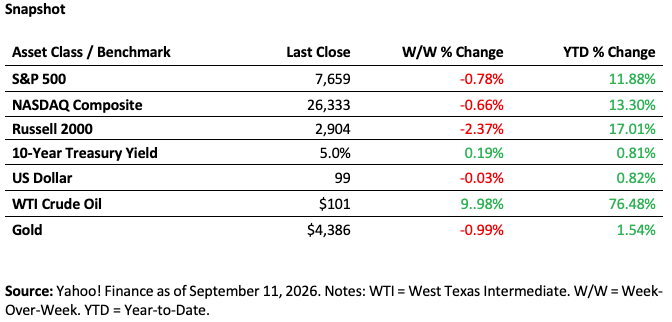
U.S. equities finished the week lower as September volatility began to show across the major indexes. The S&P 500 declined –0.78%, bringing its year-to-date gain to +11.88%. The NASDAQ Composite fell –0.66% but remains up +13.30% year-to-date. Small-cap stocks experienced the largest pullback, with the Russell 2000 declining –2.37% for the week, though it continues to lead the major indexes with a +17.01% year-to-date gain.
Treasury yields moved noticeably higher. The 10-Year Treasury yield increased +0.19%, finishing the week at 5.0%. With the 10-year yield reaching the 5% level, interest rates remain an important consideration for investors as higher yields influence borrowing costs, fixed-income markets, and equity valuations.
The U.S. dollar declined –0.03% during the week and remains modestly positive at +0.82% year-to-date.
Commodities presented a sharply divided picture. WTI crude oil surged +9.98% for the week, pushing its year-to-date advance to an extraordinary +76.48%. Gold moved in the opposite direction, declining –0.99%, although it remains +1.54% higher year-to-date.
Overall, the week reflected the type of cross-asset volatility investors may encounter as markets move further into September. Equities pulled back, Treasury yields climbed, and crude oil recorded another substantial advance. Importantly, despite this week's declines, all three major equity benchmarks in the snapshot remain solidly positive for the year.
Boaz Weinstein's investment approach offers an appropriate perspective for this environment. As founder and CIO of Saba Capital Management, Weinstein has built his career around identifying market dislocations, managing risk, and seeking asymmetric opportunities, particularly during periods of volatility. Saba Capital Markets do not need to move smoothly for long-term opportunities to remain intact. Sometimes volatility is simply the price investors pay for staying invested through uncertainty.
A Self-Driving Car in Oahu—and a Big Question About Intelligence
“The real problem is not whether machines think but whether men do”— B.F. Skinner
Sometimes a very big question begins with an ordinary experience.
The Weekly Input begins with a trip to the north shore of Oahu to drop a son off at college. Instead of renting a traditional car at the airport, the family used Turo and rented a 2026 Tesla Model Y equipped with Full Self-Driving (Supervised).
Experiencing the technology from behind the wheel for the first time was both exhilarating and unsettling. But something interesting happened as the drive continued: trust gradually began to build.
The car merged into traffic, changed lanes, adjusted its speed, and responded to rain and other obstacles. It demonstrated capabilities that only a generation ago would have seemed like science fiction.
It wasn't perfect.
Parking could be awkward. The vehicle didn't always recognize the ideal parking space immediately, nor did it consistently position itself perfectly between the painted lines. Yet those imperfections raised a much bigger question.
Does intelligence have to be perfect before it becomes useful?
That question leads directly to Artificial General Intelligence—or AGI.
According to Stanford University's Human-Centered Artificial Intelligence, AGI generally refers to AI with broad, human-level—or potentially greater—ability to learn, reason, and apply knowledge across many different tasks and domains. Unlike narrow AI designed primarily for particular tasks, AGI would be able to apply intelligence more generally.
But perhaps our expectations for artificial intelligence are sometimes unrealistic.
Humans aren't perfect either. Drivers miss turns. Investors misread markets. Forecasts prove wrong. Experts disagree. Yet we don't conclude that human intelligence is useless simply because it makes mistakes.
The self-driving experience offers a useful way to think about the next stage of AI.
Transformative technologies rarely arrive fully formed. They improve incrementally. People experiment with them, discover their weaknesses, improve them, and gradually begin trusting them with more important tasks.
The important question may therefore not be:
“When will artificial intelligence become perfect?”
A better question may be:
“When will artificial intelligence become useful enough to meaningfully change what humans can accomplish?”
That transition may already be underway.
What Exactly Is AGI?
“Some people call this artificial intelligence, but the reality is this technology will enhance us. So instead of artificial intelligence, I think we’ll augment our intelligence.” — Ginni Rometty
Artificial General Intelligence sounds futuristic, but the underlying idea is relatively straightforward.
The Weekly Input describes AGI as artificial intelligence with broad, general capabilities that can learn, reason, and apply knowledge across many different tasks and domains at roughly human-level capability or beyond, rather than being limited to one narrow task.
That distinction matters.
Much of the artificial intelligence we have traditionally used has been specialized. One system might recognize images. Another might recommend a movie. Another might translate languages or analyze financial information.
AGI represents something broader.
Imagine an AI system capable of taking knowledge learned in one area and applying it to a completely different problem. Instead of merely responding to one specialized instruction, it could reason across subjects, adapt to unfamiliar situations, and independently handle different types of tasks.
But defining the finish line is difficult.
There is currently no universally accepted test for AGI and no universally agreed definition of exactly what constitutes “human-level intelligence.” Some believe AGI is already beginning to emerge. Others believe it remains decades away.
That ambiguity may mean society doesn't recognize AGI the moment it arrives.
We may identify it only afterward.
Technology often advances that way. There wasn't one universally recognized morning when society suddenly became “digital.” Computers, the internet, smartphones, cloud computing, and eventually AI gradually became woven into everyday life.
AGI may follow a similar path.
Rather than arriving with a dramatic announcement, it may emerge through thousands of incremental improvements until one day we look back and realize:
The machines stopped being good at just one thing and became capable of helping us with almost everything.
Will We Reach AGI Soon?
AGI Does Not Equal Perfection
“Success is stumbling from failure to failure with no loss of enthusiasm.” — Winston Churchill
Artificial General Intelligence may sound like something far in the future, but the Weekly Input raises an intriguing possibility: the best frontier AI models could potentially achieve AGI by 2030. That is only a few years away.
But determining when AGI actually arrives may be harder than predicting the technology itself.
There is currently no universally accepted test for AGI or even complete agreement about what qualifies as “human-level intelligence.” Some believe AGI is already emerging, while others think it remains decades away. We may only recognize the milestone after the fact. Stanford HAI similarly notes that AGI has no universally accepted test and that definitions of human-level intelligence differ. Stanford HAI
The Weekly Input makes an important distinction: AGI does not equal perfection.
Today's leading AI models still hallucinate, omit relevant information, and make mistakes. A self-driving vehicle may navigate traffic exceptionally well yet struggle to park perfectly between two white lines. But imperfection does not make either technology useless.
Consider a hypothetical example from the Weekly Input. Suppose future AI systems became 99.9% accurate in critical applications such as autonomous transportation, medical analysis, engineering, or physical safety, while achieving only 80% accuracy on highly theoretical or hypothetical questions. Would that be intelligent enough to qualify as AGI? Where should the line be drawn?
There may never be an AI—or a human—that perfectly predicts next month's weather, the economy, or financial markets.
And perhaps that isn't the standard that matters.
For consumers and investors, the more important question may be whether AI becomes capable enough to solve meaningful problems, improve productivity, augment human decision-making, and make everyday life safer and more efficient.
AGI doesn't have to be perfect to be powerful. It only has to become useful enough to change what is possible.
Imperfect Intelligence Is Still Powerful
“If you want to increase your success rate, double your failure rate.” — Thomas J. Watson Sr.
One of the most important ideas in this Weekly Input is surprisingly simple:
Something does not have to be perfect to be incredibly useful.
We sometimes hold artificial intelligence to a standard we don't apply to ourselves.
Humans make mistakes every day. Drivers miss exits. Weather forecasts change. Investors make incorrect predictions. Professionals sometimes disagree about the same set of facts.
Yet imperfection doesn't make human intelligence worthless.
The same principle applies to AI.
Today's leading models can still hallucinate—producing information that sounds plausible but is inaccurate. They can omit relevant information or misunderstand what a user is asking. Some models perform better than others at applying general knowledge across different subjects and tasks.
The self-driving experience described in the Weekly Input provides a physical example.
The vehicle could be cautious when merging, changing lanes, and adjusting its speed for rain or other obstacles while still being imperfect at something seemingly simpler: parking between two white lines.
Intelligence isn't necessarily all or nothing.
A technology can be extraordinary at one task and mediocre at another—and still create tremendous value.
That distinction becomes especially important as AI moves into areas such as autonomous transportation, medical analysis, engineering, architecture, and other complex applications.
The Weekly Input also makes clear that human oversight remains important. AI systems can still generate inaccurate, incomplete, outdated, biased, or unsupported information, particularly in high-stakes situations.
But usefulness and perfection are two different standards.
The biggest societal benefits from AI may arrive long before AI stops making mistakes.
And that may be one of the most important lessons as we move toward AGI:
Imperfect intelligence can still be extraordinarily powerful.
Fun Facts & Figures
How Intelligent Is Intelligent Enough?
“The measure of intelligence is the ability to change.” — Commonly attributed to Albert Einstein
🚗 2026 Model Y — Jim's first supervised self-driving experience came in Hawaii behind the wheel of a Tesla Model Y equipped with Full Self-Driving (Supervised). Despite the name, the system still requires active driver supervision.
🧠 2030? — Jim believes leading frontier models could reach AGI by 2030, while acknowledging that experts disagree substantially about the timing and even the definition of AGI.
🎯 99.9% vs. 80% — The Weekly Input uses a hypothetical example: imagine AI reaching 99.9% accuracy on critical tasks but only 80% on theoretical ones. Would that be intelligent enough to qualify as AGI? The numbers are illustrative—not forecasts or measured performance.
🤖 AGI ≠ ASI — Artificial General Intelligence broadly refers to human-level general capabilities. Artificial Superintelligence describes the hypothetical possibility of intelligence substantially exceeding human cognitive abilities across most domains.
🚘 30%–50% Fewer Accidents? — Jim uses another hypothetical example: if autonomous vehicles could someday reduce automobile accidents by even 30%–50%, the societal benefit could be enormous. The range is illustrative rather than a prediction.
🎭 Robots on Broadway — Maybe Happy Ending uses two aging helper robots to explore love, purpose, obsolescence, and the surprisingly human beauty of imperfection.
💡 Physical AI Is Already Here — The term includes AI operating in the physical world through robots, autonomous vehicles, and other machines—not merely software responding from a computer screen.
On This Day in History — September 14
“The future depends on what we do in the present” — Mahatma Gandhi
The First Human-Made Object Reaches Another World
On September 14, 1959, the Soviet spacecraft Luna 2 became the first human-made object to reach the Moon.
Today, reaching the Moon is part of history. In 1959, it represented an extraordinary technological leap.
That makes Luna 2 an especially fitting milestone for this week's discussion of artificial intelligence.
Transformative technologies often appear impossible—until suddenly they aren't. Spaceflight, personal computers, smartphones, autonomous vehicles, and modern AI each demonstrate humanity's ability to turn ideas once confined to imagination into practical reality.
AGI may someday join that list.
Other September 14 Milestones
🏛️ 1814 — “The Star-Spangled Banner” Is Written: After witnessing the bombardment of Fort McHenry, Francis Scott Key wrote the poem that eventually became the lyrics of the U.S. national anthem.
🎨 1901 — Theodore Roosevelt Becomes President: Following the death of William McKinley, Roosevelt became the 26th President of the United States, beginning an era associated with economic reform, conservation, and America's growing global influence.
🚁 1939 — The VS-300 Takes Flight: Aviation pioneer Igor Sikorsky flew an early version of the VS-300 helicopter, helping establish the configuration that would influence modern helicopter design.
🌕 1959 — Luna 2 Reaches the Moon: Humanity demonstrated for the first time that a machine built on Earth could physically reach another celestial body.
🛰️ 1968 — Zond 5 Launches Toward the Moon: The Soviet spacecraft became the first mission to carry Earth organisms around the Moon and return them safely to Earth.
💻 2000 — Microsoft Launches Windows Me: Another milestone in the rapid evolution of personal computing—a reminder that technological progress is rarely a straight line and not every innovation becomes a lasting winner.
History gives us perspective.
The technologies that eventually change the world often begin as experiments—imperfect, uncertain, and easy to underestimate.
That sounds remarkably similar to where artificial intelligence stands today.
“Anything one man can imagine, other men can make real.”— Jules Verne
Sources & Footnotes:
- The Wealth Consulting Group — Weekly Input, “What is AGI and What Does It Mean For Us?” (September 10, 2026). Primary source for this week’s discussion of Artificial General Intelligence, autonomous vehicles, the potential development of AGI, and the idea that intelligence does not have to be perfect to be useful.
- Stanford University, Stanford Institute for Human-Centered Artificial Intelligence (HAI) — “What is AGI (Artificial General Intelligence)?” Stanford describes AGI as an AI system with general, human-level—or beyond—ability to learn, reason, and apply knowledge across a wide range of tasks and domains. Stanford also notes that there is no universally accepted test for determining whether AGI has been achieved.
- Weekly Input — Full Self-Driving Experience. The commentary begins with a 2026 Tesla Model Y equipped with Full Self-Driving (Supervised) in Oahu. The experience—initially exhilarating and unsettling, followed by increasing trust—provides the framework for considering when increasingly capable artificial intelligence might qualify as AGI.
- Weekly Input — Defining AGI. AGI is described as broad artificial intelligence capable of learning, reasoning, and applying knowledge across many different tasks and domains, rather than remaining limited to a single narrow function. The Weekly Input also emphasizes the difficulty of establishing a universally accepted threshold for “human-level” intelligence.
- Weekly Input — Potential AGI Timeline. The Weekly Input expresses the opinion that the best frontier AI models could potentially achieve AGI by 2030. This is presented as an opinion rather than a prediction or guarantee, and the exact timing remains uncertain because there is no standardized definition or test for AGI.
- Weekly Input — AGI Does Not Equal Perfection. The Weekly Input emphasizes that AGI should not necessarily be equated with flawless performance. Current AI systems can hallucinate, omit relevant information, or perform inconsistently across tasks, while still providing substantial practical value.
- Weekly Input — The Self-Driving Example. Full Self-Driving (Supervised) demonstrated caution while merging, changing lanes, and responding to rain or other obstructions, yet it did not always identify or execute the ideal parking maneuver. The example illustrates the broader theme that imperfection and usefulness can coexist.
- Weekly Input — The Accuracy Thought Experiment. The Weekly Input considers a hypothetical system that is 99.9% accurate on critical tasks but only 80% accurate on hypothetical or theoretical questions, raising the question of where society should draw the line for human-level intelligence. These percentages are illustrative examples and are not measurements, forecasts, or guarantees of AI performance.
- Weekly Input — AI Limitations and Human Oversight. AI systems may produce inaccurate, incomplete, outdated, biased, or unsupported outputs. Human review, independent verification, appropriate controls, and awareness of system limitations remain particularly important when AI is used for high-stakes applications.
- Quotations. Quotations appearing in Sections 1–4 are attributed to B.F. Skinner, Ginni Rometty, Winston Churchill, and Thomas J. Watson Sr. Quotations should be independently verified against original or authoritative sources before publication, consistent with the source-verification guidance contained in the Weekly Input.
- Important Disclosure. Statements regarding the timing, development, adoption, capabilities, benefits, risks, or societal effects of AI and AGI are forward-looking opinions and inherently uncertain. This material is intended for informational and educational purposes and should not be interpreted as individualized investment advice or as a prediction of future investment performance.
Disclosures:
Securities offered through LPL Financial, Member FINRA/SIPC. Investment Advice offered through WCG Wealth Advisors, LLC, a Registered Investment Advisor. WCG Wealth Advisors, LLC is a separate entity from LPL Financial.
Bond yields are subject to change. Certain call or special redemption features may exist which could impact yield. (118-LPL)
The S&P 500 is a stock market index tracking the stock performance of 500 of the largest companies listed on stock exchanges in the United States. Indexes are unmanaged and cannot be invested in directly. (102-LPL)
The NASDAQ Composite Index measures all NASDAQ domestic and non-U.S. based common stocks listed on The NASDAQ Stock Market. The market value, the last sale price multiplied by total shares outstanding, is calculated throughout the trading day, and is related to the total value of the Index. Indexes are unmanaged and cannot be invested in directly. (112-LPL)
The fast price swings in commodities will result in significant volatility in an investor’s holdings. Commodities include increased risks, such as political, economic, and currency instability, and may not be suitable for all investors. (122-LPL)
There is no guarantee that a diversified portfolio will enhance overall returns or outperform a non-diversified portfolio. Diversification does not protect against market risk. (26-LPL)
The Russell 2000 Index is generally representative of the 2,000 smallest companies by market capitalization in the Russell 3000 index, which represents approximately 10% of the total market capitalization of the Russell 3000 Index. Indexes are unmanaged and cannot be invested in directly. Bonds are subject to market and interest rate risk if sold prior to maturity. Bond values will decline as interest rates rise. Bonds are subject to availability, change in price, call features and credit risk. The fast price swings in commodities will result in significant volatility in an investor’s holdings. Commodities include increased risks, such as political, economic, and currency instability, and may not be suitable for all investors.
Securities offered through LPL Financial, Member FINRA/SIPC. Investment Advice offered through WCG Wealth Advisors, LLC, a Registered Investment Advisor. WCG Wealth Advisors, LLC is a separate entity from LPL Financial.
1174746-091426